
Introduction
SJVNL has issued a tender for a 265 MW / 530 MWh battery energy storage system (BESS) under the VGF scheme in Haryana. The project seeks four developers to design, commission and operate a two‑hour duration BESS that can deliver one cycle per day. Stakeholders including developers, financiers, and policymakers will find the timeline and eligibility details crucial for planning. This article breaks down the tender timeline, technical and financial eligibility, and the potential impact on India’s renewable storage market.
What Does the Data Reveal About This Topic?
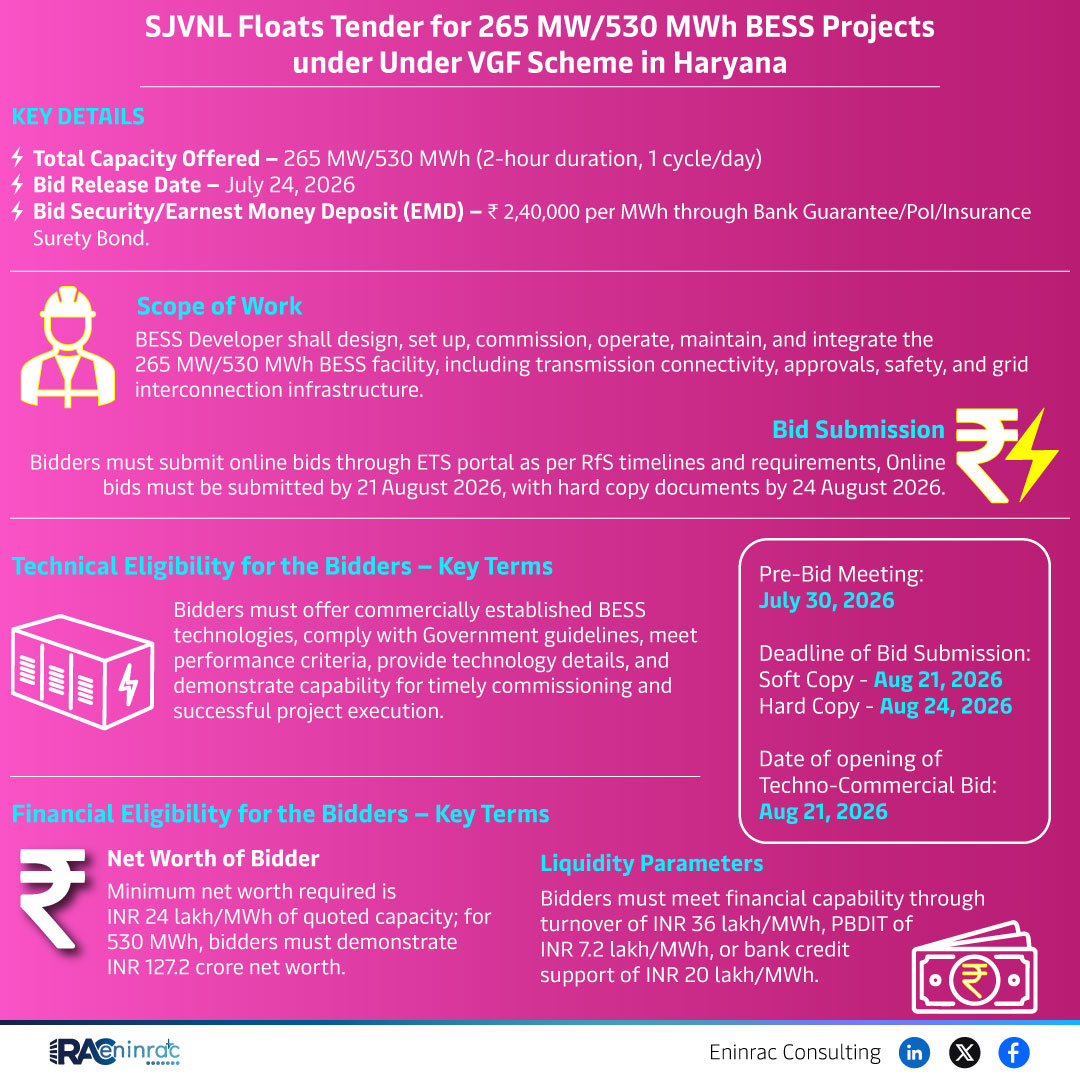
The raw data shows that the total capacity offered is 265 MW with a 530 MWh storage size, a bid security of INR 2.4 lakh per MWh, and strict financial thresholds such as a net‑worth of INR 127.2 crore. It also outlines key dates: pre‑bid meeting on 30 July 2026, online submission by 21 August 2026 and hard‑copy delivery by 24 August 2026. These parameters reflect the government's intent to ensure financially robust participants and to mitigate project risk. By tying bid security to per‑MWh values, the tender aligns stakeholder commitment with the scale of the storage asset.
Tender Timeline and Financial Requirements
The tender schedule is tightly defined. A pre‑bid meeting on 30 July 2026 introduces bidders to the project scope, after which online bids must be uploaded to the ETS portal by 21 August 2026. Hard‑copy documents are required by 24 August 2026 for verification. Financial eligibility mandates a minimum net worth of INR 24 lakh per MWh, translating to INR 127.2 crore for the full 265 MW capacity, and a turnover of INR 36 lakh per MWh with a PBDIT of INR 7.2 lakh per MWh or equivalent bank credit of INR 20 lakh per MWh.
Impact on Sectors and Industries
The addition of a 265 MW BESS in Haryana strengthens grid stability and enables higher penetration of solar and wind projects in northern India. Energy traders gain a flexible reserve that can smooth intermittent generation, while utilities benefit from reduced curtailment costs. Investors see a clear policy signal that storage is being monetised through VGF incentives, encouraging further private capital into battery manufacturing and ancillary services. Moreover, the BESS can provide ancillary services such as frequency regulation, voltage support, and spinning reserve, opening new revenue streams for operators.
Key Takeaways
- Total BESS capacity offered is 265 MW with 530 MWh storage.
- Bid security required is INR 2.4 lakh per MWh via bank guarantee.
- Financial eligibility demands INR 127.2 crore net worth for full capacity.
- Online bid submission deadline is 21 August 2026; hard copy by 24 August.
- Pre‑bid meeting scheduled for 30 July 2026 outlines technical expectations.
- Project supports VGF scheme, enhancing renewable storage deployment in Haryana.
FAQs
What is the total capacity and duration of the BESS tender?
The tender offers a 265 MW system with 530 MWh storage, delivering a two‑hour duration and one cycle per day.
When must bidders submit their online and hard‑copy bids?
Online bids are due by 21 August 2026 through the ETS portal, and hard‑copy documents must be submitted by 24 August 2026.
What financial criteria must bidders meet to be eligible?
Bidders need a net worth of INR 24 lakh per MWh (INR 127.2 crore total), turnover of INR 36 lakh per MWh, and PBDIT of INR 7.2 lakh per MWh or equivalent bank credit.
How does the BESS project benefit the regional power grid?
The BESS enhances grid stability, reduces renewable curtailment, and provides ancillary services such as frequency regulation and voltage support.
Which government scheme backs this BESS tender?
The project is funded under the Viability Gap Funding (VGF) scheme, aimed at supporting large‑scale renewable storage initiatives.