
Introduction
Small hydro power generation in India continues to play a vital role in the nation renewable energy mix. The April 2026 data highlights how states are contributing to clean electricity through small hydro projects. This article examines the latest capacity figures measured in million units (MU) and gigawatts (GW), state level leadership, monthly capacity additions, and growth trends. Readers will learn which states lead in small hydro power generation, how capacity has evolved over the first quarter of 2026, and what the numbers mean for the broader energy sector. With decentralized generation gaining policy support, understanding these statistics helps stakeholders identify opportunities and risks in the small hydro segment.
What Does the Data Reveal About This Topic?
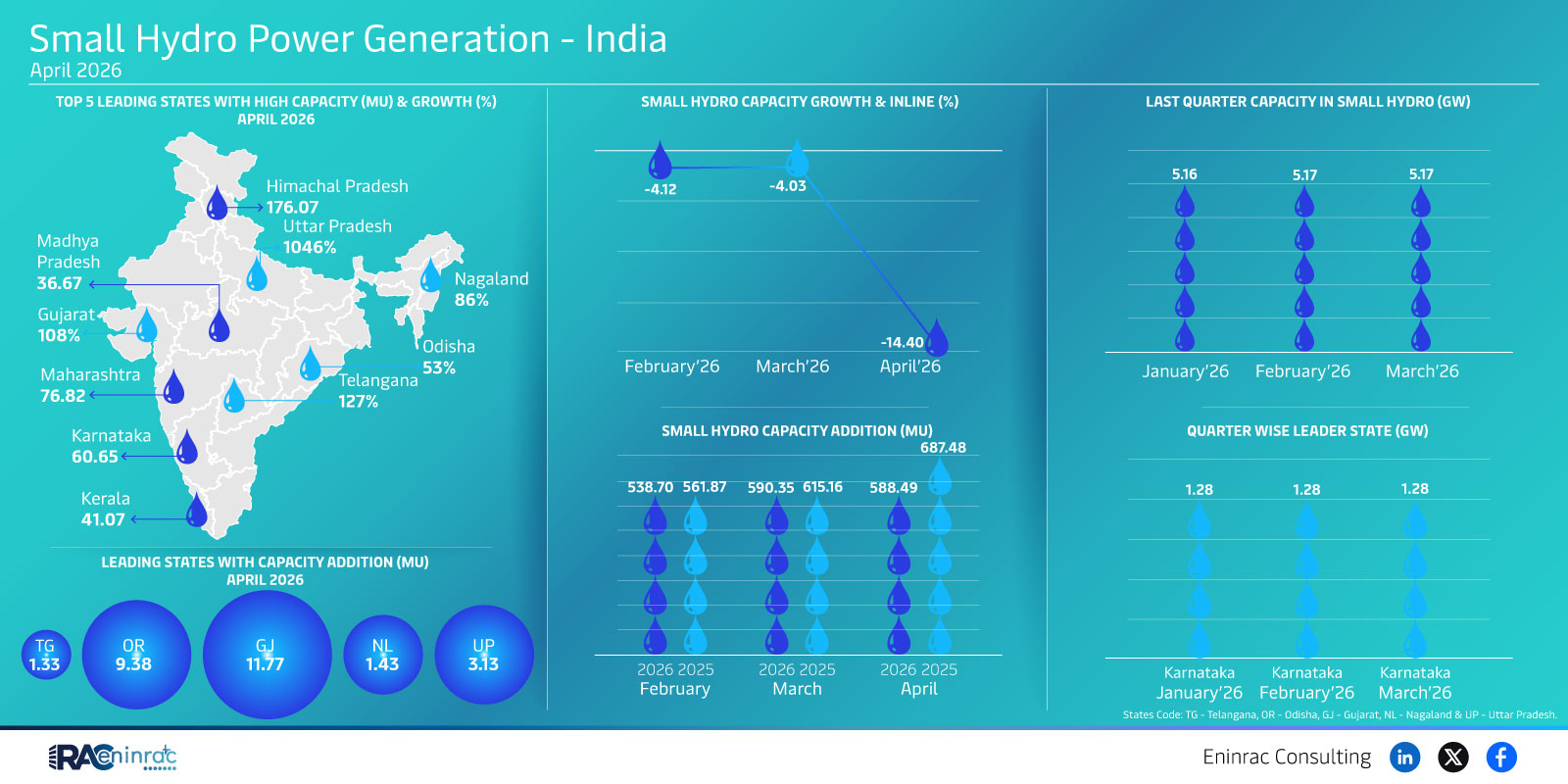
What is the current leadership landscape in small hydro power generation? The raw data shows Himachal Pradesh at the forefront with 176.07 MU of high capacity, followed by Gujarat at 108 MU, Maharashtra at 76.82 MU, Karnataka at 60.65 MU, and Kerala at 41.07 MU. Uttar Pradesh and Madhya Pradesh also appear with Madhya Pradesh recording 36.67 MU. On a quarterly basis, Karnataka emerged as the leader in February, March, and April 2026 with a last quarter capacity of 1.28 GW. Capacity addition in the small hydro segment reached 687.48 MU, though growth indicators such as negative figures of -4.03 and -14.40 suggest some periods experienced contraction. These insights provide a clear snapshot of regional strengths and temporary slowdowns in small hydro power generation across India.
State-Wise Capacity and Karnataka's Quarter-Wise Dominance
A comparative interpretation of the data reveals a distinct regional pattern in small hydro power generation. Himachal Pradesh leads in absolute MU capacity, reflecting its mountainous terrain suited for hydro projects. Gujarat and Maharashtra follow with substantial contributions from diverse projects. Meanwhile, Karnataka demonstrates consistent quarter-wise leadership with 1.28 GW capacity in the last quarter and topping February, March, and April 2026. The capacity addition figures show monthly values around 61.87, 590.35, 615.16, and 588.49 MU, indicating that most addition occurred in later months. Negative growth markers of -4.03 and -14.40 highlight that not all periods saw expansion, possibly due to seasonal flow variations or maintenance. This contrast between steady state leadership and fluctuating additions underscores the dynamic nature of small hydro power generation in India.
Impact on Sectors and Industries
The trends in small hydro power generation significantly impact multiple sectors. For renewable energy investors, the dominance of states like Himachal and Karnataka signals stable regions for project development. Policymakers can use the state-wise data to target incentives where capacity lags, such as Madhya Pradesh or Uttar Pradesh. Distribution companies benefit from localized generation that reduces transmission losses. Equipment manufacturers see demand correlated with capacity addition spikes near 615 MU in March. Consumers in leading states enjoy cleaner power and potential cost stability. Overall, the small hydro power generation landscape influences market strategies, regulatory focus, and rural electrification outcomes across India.
Key Takeaways
- Himachal Pradesh leads small hydro power generation with 176.07 MU capacity in April 2026.
- Gujarat, Maharashtra, Karnataka, and Kerala follow as top contributing states with significant MU outputs.
- Karnataka recorded 1.28 GW last quarter capacity and led in February, March, and April 2026.
- Total small hydro capacity addition reached 687.48 MU with monthly figures showing variability.
- Growth rates showed negative values of -4.03 and -14.40 indicating periodic contraction in the segment.
- Madhya Pradesh and Uttar Pradesh remain part of the state landscape with MP at 36.67 MU capacity.
FAQs
Which state leads in small hydro power generation in India April 2026?
Himachal Pradesh leads with 176.07 MU of capacity, followed by Gujarat with 108 MU and Maharashtra with 76.82 MU.
What is Karnataka role in quarter-wise small hydro capacity?
Karnataka led in February, March, and April 2026 with last quarter capacity of 1.28 GW, showing consistent leadership.
How much small hydro capacity was added in the recent period?
Total capacity addition stood at 687.48 MU, with monthly additions around 61.87, 590.35, 615.16, and 588.49 MU.
Did small hydro power generation show negative growth?
Yes, the data indicates negative growth figures of -4.03 and -14.40 in some periods, reflecting temporary declines.
Why is small hydro power generation important for India?
It provides decentralized renewable energy, reduces transmission losses, supports rural electrification, and aids climate goals.