
Introduction
India’s Production Linked Incentive (PLI) scheme has accelerated the establishment of advanced copper‑clad (ACC) battery storage facilities across the country. By March 2026 a total of 190 units have been approved, reflecting the government’s push toward clean energy storage and grid stability. The data reveals how each state is contributing to this emerging sector, highlighting regional strengths, policy effectiveness, and investment patterns. Readers will discover which states lead the rollout, how the distribution compares to national targets, and what the implications are for manufacturers, investors, and policymakers seeking to capitalize on the rapid growth of battery storage in India. Understanding this geographical spread helps stakeholders align resources, anticipate supply chain demands, and plan for future capacity expansions in line with renewable energy goals. The dataset also serves as a benchmark for upcoming policy revisions.
What Does the Data Reveal About This Topic?
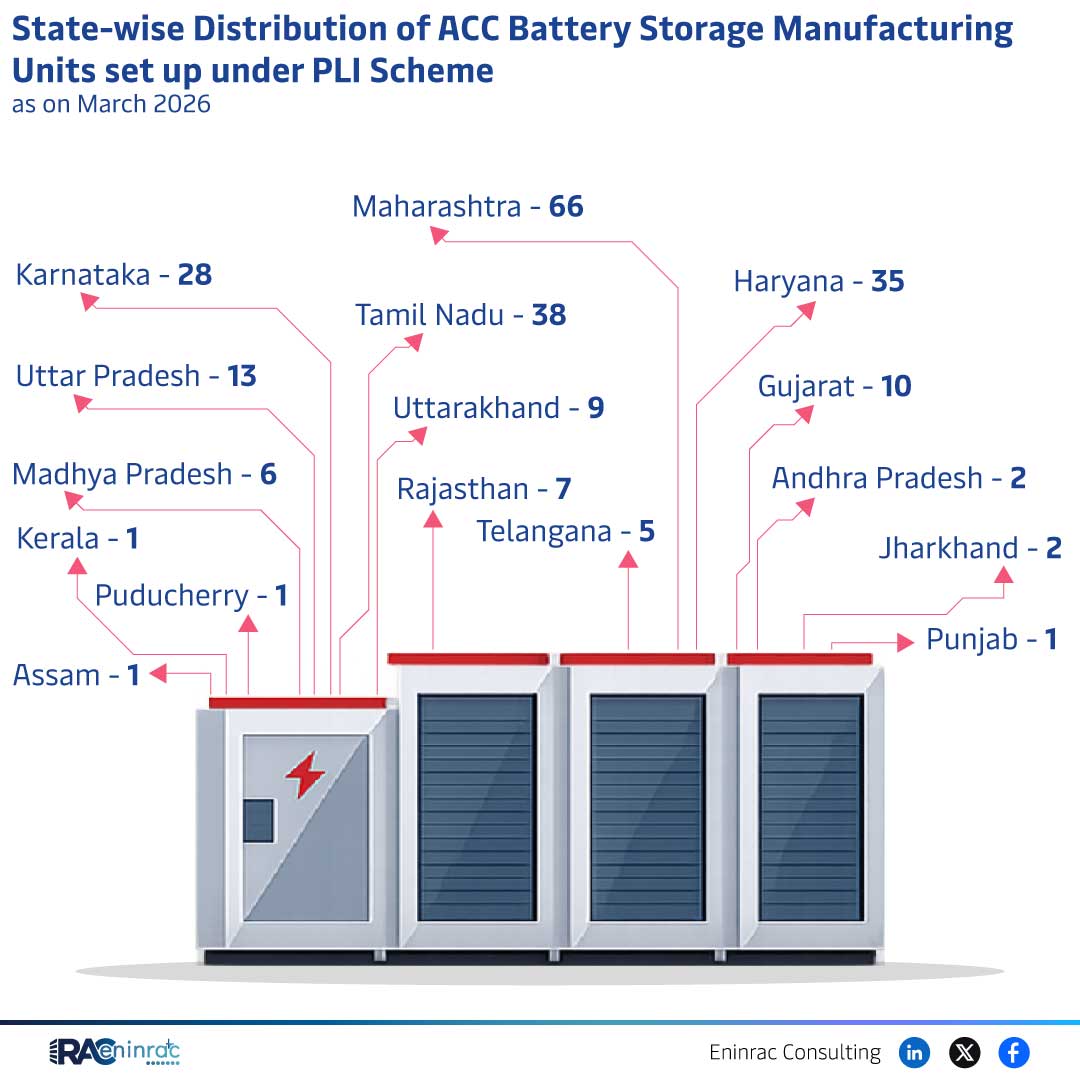
The key question is which Indian states are most active in establishing ACC battery storage units under the PLI scheme. Maharashtra tops the list with 66 units, followed by Haryana with 35 and Tamil Nadu with 38. Karnataka, Uttar Pradesh and Gujarat also show noticeable activity. The distribution indicates a concentration in western and southern regions, while many northern and northeastern states have fewer installations. This pattern reflects differences in industrial infrastructure, state‑level incentives and the presence of renewable projects requiring storage. Comparing state totals therefore illustrates varying policy implementation and market readiness across India.
State-wise Comparison of ACC Battery Storage Units
When the numbers are placed side by side, Maharashtra’s 66 units stand out as a clear leader, representing more than a third of all approved facilities. Karnataka and Tamil Nadu each host between 28 and 38 units, showing strong participation from the south‑west and south‑east corridors. Haryana’s 35 units place it ahead of many larger states, underscoring the impact of proactive state policies. In contrast, states such as Uttarakhand, Kerala, Punjab and Puducherry have a single unit each, highlighting limited industrial focus or nascent market development. The overall picture suggests that states with robust manufacturing ecosystems and favorable renewable energy targets are attracting the majority of PLI‑driven battery storage projects.
Impact on Sectors and Industries
The concentration of ACC battery storage units influences several sectors. Manufacturing firms gain access to domestic supply chains, reducing dependence on imports. Power utilities benefit from enhanced grid stability and the ability to store excess renewable generation. Investors see clearer signals for capital allocation toward regions with proven policy support. Policymakers can use the distribution data to fine‑tune incentive structures, ensuring balanced regional growth and addressing gaps in the northeast and central zones. Additionally, ancillary industries such as components, logistics and engineering services experience demand growth linked to the expanding battery storage ecosystem.
Key Takeaways
- Maharashtra leads with 66 ACC battery storage units.
- Southern and western states dominate the PLI rollout.
- Only a handful of units are present in northern and northeastern states.
- State policies and infrastructure drive the uneven distribution.
- The data guides investors toward high‑activity regions.
- Balanced growth may require targeted incentives for lagging states.
FAQs
Which state has the highest number of ACC battery storage units?
Maharashtra, with 66 approved units as of March 2026.
How many total ACC battery storage units are approved under the PLI scheme?
A total of 190 units have been set up across India.
Why do southern states show strong participation?
They benefit from established manufacturing hubs and supportive state incentives.
What impact does this distribution have on renewable energy integration?
Concentrated storage capacity enhances grid reliability and enables higher renewable penetration.
Can the data influence future policy decisions?
Yes, it helps policymakers target incentives to under‑served regions and balance national growth.