
Introduction
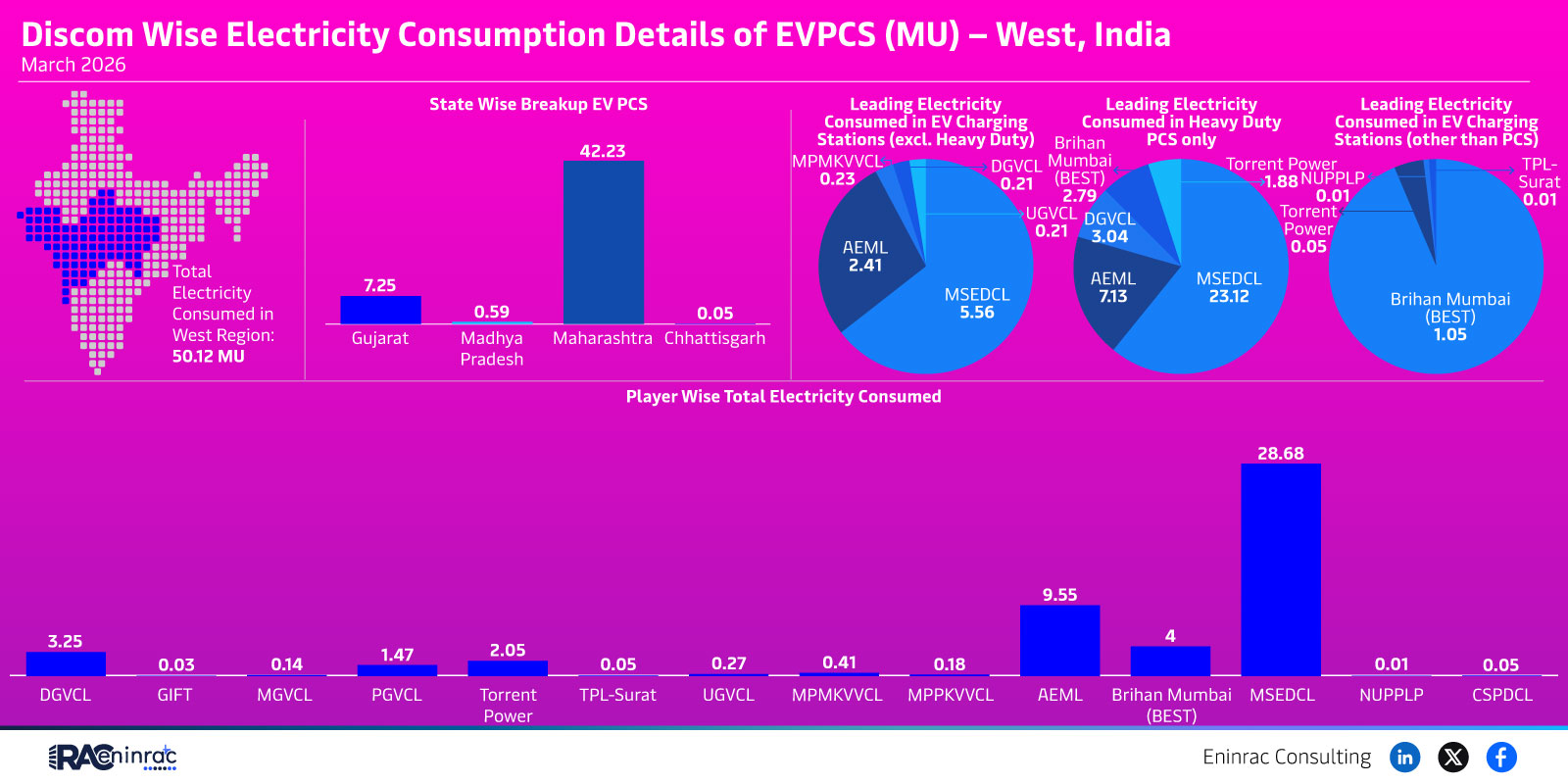
The West region of India recorded detailed electricity consumption by distribution companies (Discoms) for electric vehicle (EV) public charging stations (EVPCS) in March 2026. Understanding how much power each Discom supplied to EV charging helps policymakers, investors, and industry players gauge the growth of EV infrastructure, identify leading states, and plan future investments. This article breaks down the consumption figures, highlights the top‑performing Discoms, explains regional differences, and describes the broader impact on the power sector, renewable energy development, and automotive markets.
What Does the Data Reveal About This Topic?
The data shows that the total electricity consumed by EV charging stations in the West region reached approximately 59 MU, with Gujarat contributing the largest share at over 42 MU, followed by Maharashtra and Madhya Pradesh. Heavy‑duty EV charging accounted for only a small fraction of the overall usage, indicating that most of the demand comes from standard public chargers used by everyday commuters. The leading Discoms such as DGVCL, MGVCL, and MSEDCL delivered the highest volumes, signaling where EV adoption is strongest and where grid upgrades may be required.
Regional and Discom Performance Comparison
Gujarat’s Discoms collectively consumed more than 42 MU, dwarfing the 7.25 MU recorded in Maharashtra and the 3.25 MU in Madhya Pradesh. Within Gujarat, DGVCL reported the highest single‑entity consumption at around 10 MU, while PGVCL and MGVCL each supplied roughly 5 MU. In Maharashtra, Brihan‑Mumbai (BEST) contributed 0.21 MU for regular EV charging and 1.88 MU for heavy‑duty charging, reflecting a modest but growing market. The contrast between states highlights Gujarat’s aggressive rollout of public chargers, supported by state policies and private investments, whereas neighboring states are still in earlier stages of infrastructure deployment.
Impact on Sectors and Industries
Higher electricity usage for EV charging drives demand for renewable generation, grid upgrades, and smart‑metering solutions. Distribution companies must invest in capacity expansion and advanced load‑management to avoid congestion, while renewable developers see new off‑take opportunities as utilities seek cleaner sources for EV power. Automotive manufacturers benefit from increased consumer confidence as charging availability improves, and investors can target utilities with strong EV charging portfolios. Policymakers can use this consumption data to allocate subsidies, design incentives, and set targets for sustainable mobility.
Key Takeaways
- West India’s EV charging consumption reached roughly 59 MU in March 2026.
- Gujarat led the region with over 42 MU, far ahead of Maharashtra and Madhya Pradesh.
- DGVCL, MGVCL and PGVCL were the top‑performing Discoms in terms of power supplied.
- Heavy‑duty EV charging remains a minor portion of total consumption.
- The data underscores a rapid expansion of EV infrastructure in Gujarat.
- Growth in EV charging demand signals opportunities for renewable energy and grid modernization.
FAQs
Which state consumed the most electricity for EV charging in West India?
Gujarat, with more than 42 million units (MU) consumed during March 2026.
What is the total EV charging electricity consumption in the West region?
Approximately 59 MU was used by public EV charging stations in March 2026.
Do heavy‑duty EV chargers use a large share of electricity?
No, heavy‑duty charging accounts for a small fraction of the total consumption.
Which Discom supplied the highest amount of power for EV charging?
DGVCL delivered the highest single‑entity consumption, around 10 MU in March 2026.
How can investors benefit from this consumption data?
Investors can identify utilities with growing EV charging portfolios and target renewable projects that will meet the rising demand.