
Introduction
The August 2026 snapshot of peak power demand West India provides a critical view of how electricity consumption spikes across the region during peak summer conditions. Understanding these numbers helps utilities, policymakers, investors and researchers gauge stress points in the grid, plan capacity upgrades and anticipate future demand patterns. This article breaks down the state‑wise figures, highlights the leading demand centres and explores the broader implications for the power sector in Western India.
What Does the Data Reveal About This Topic?
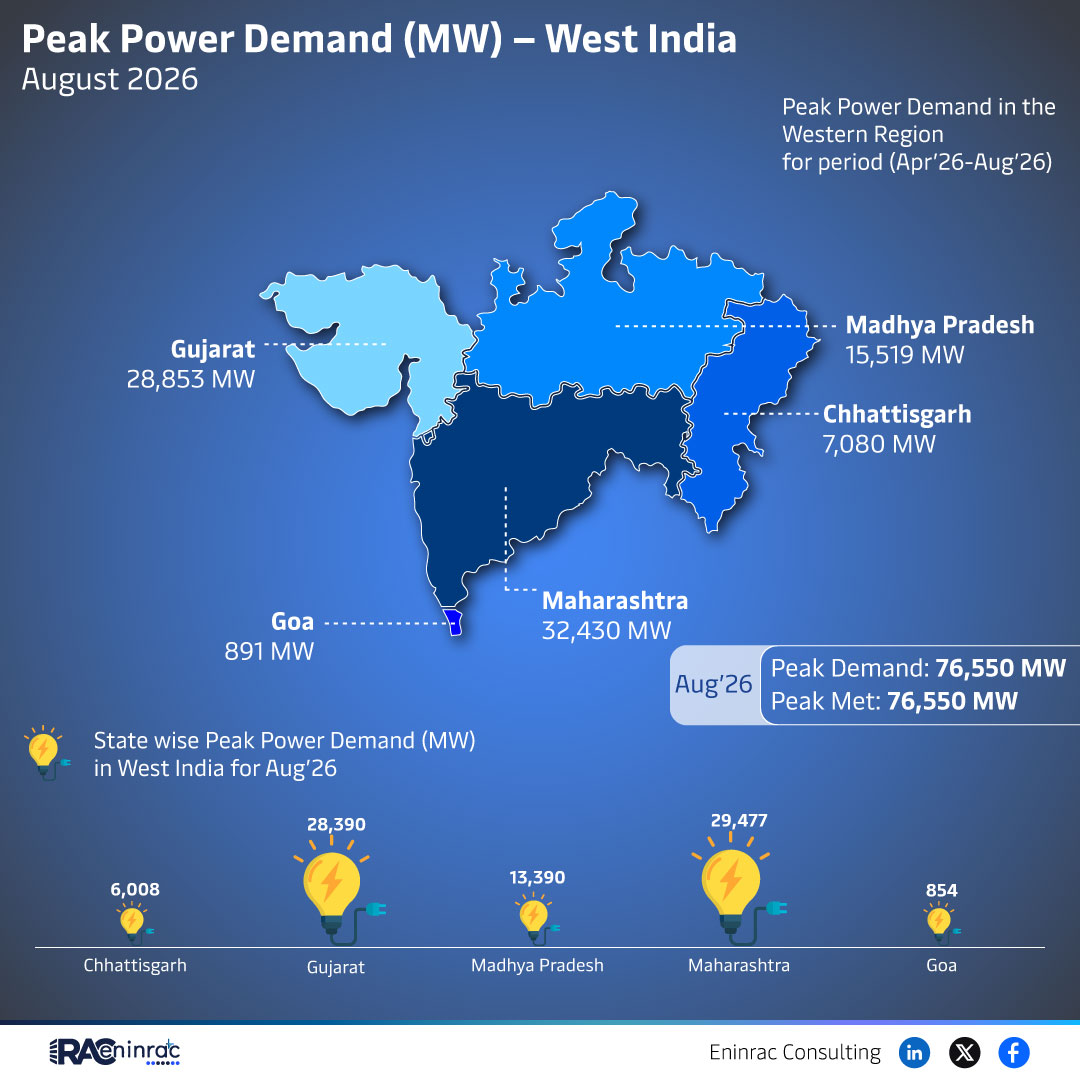
The raw data shows that the combined peak load for West India reached 76,550 MW in August 2026, with Maharashtra and Gujarat accounting for the largest shares. Maharashtra recorded approximately 32,430 MW while Gujarat contributed about 28,853 MW. Madhya Pradesh added 15,519 MW, Chhattisgarh 7,080 MW and Goa 891 MW. The question that emerges is why these states dominate the demand curve and how their industrial, commercial and residential consumption patterns drive the overall regional peak.
State‑wise Comparison of August 2026 Peak Power Demand
A closer look reveals Maharashtra’s peak load exceeds Gujarat by roughly 3,500 MW, reflecting the state’s extensive manufacturing base, high‑density urban areas and large commercial load centres such as Mumbai and Pune. Gujarat’s demand remains strong due to its chemical and petrochemical industries, along with a growing renewable energy portfolio that still requires balancing capacity. Madhya Pradesh, while not as industrialised as its western neighbours, shows a significant demand driven by thermal power plants and expanding agricultural irrigation needs. Chhattisgarh’s modest figure aligns with its lower industrial density, and Goa’s demand stays under 1,000 MW, consistent with its smaller population and tourism‑focused economy.
Impact on Sectors and Industries
The elevated peak power demand West India influences several key sectors. Power generators must secure sufficient capacity and reserve margins, prompting accelerated commissioning of new thermal and renewable projects. Transmission operators face the task of reinforcing corridors to handle higher flows, especially between Maharashtra and Gujarat. Distribution utilities need to manage load‑shedding risk, upgrade feeder infrastructure and adopt smart‑grid solutions. For investors, the data signals growth opportunities in battery storage, demand‑response services and grid‑modernisation technologies. Policymakers can leverage these insights to shape tariff structures, encourage energy‑efficiency programmes and align renewable integration targets with real‑time demand peaks.
Key Takeaways
- Maharashtra leads West India with the highest August 2026 peak load.
- Gujarat follows closely, driven by heavy industry and renewable balancing.
- Madhya Pradesh contributes a substantial share due to thermal generation.
- Chhattisgarh and Goa show lower peaks reflecting smaller industrial bases.
- Total regional peak demand reached 76,550 MW, stressing existing grid assets.
- The figures highlight urgent needs for capacity expansion, transmission upgrades and smart‑grid adoption.
FAQs
What was the total peak power demand in West India for August 2026?
The region recorded a combined peak load of 76,550 MW.
Which state had the highest peak demand?
Maharashtra registered the highest peak demand at roughly 32,430 MW.
How does Gujarat’s demand compare to Maharashtra’s?
Gujarat’s peak demand was about 28,853 MW, roughly 3,500 MW lower than Maharashtra’s.
Why is peak demand important for the power sector?
Peak demand determines the maximum capacity the grid must support, influencing generation planning, transmission reinforcement and reliability strategies.
What actions can utilities take to manage high peak loads?
Utilities can invest in demand‑response programs, upgrade infrastructure, integrate storage solutions and promote energy‑efficiency measures.